
Skip to Main content Skip to Footer
Data as the engine for your business success

Achieve efficiency, agility, and growth in your company.

Contect experts!

Smart Data
Data-driven value creation

Today, companies generate more data than ever before – from processes, systems, products, and customer interactions. But data alone does not create added value. Only through its targeted use for informed decisions, innovative business models, and sustainable competitive advantages can real value be created – for example, through optimized processes, personalized offers, or faster decision-making.

A holistic approach is crucial: a clear data strategy, a powerful technological infrastructure, a suitable organizational framework – with defined roles, responsibilities, and competencies – and binding governance structures must work together seamlessly. Equally important are a data-oriented corporate culture and a willingness to change. When these elements are well aligned, data excellence emerges – that is, the ability to systematically use data to drive efficiency, agility, and growth in the company in a targeted manner.
With in-depth consulting experience at the interface of management, technology, and data, we are your partner on the path to becoming a data-driven organization.

Secure decisions

Data enables decisions to be made objectively and transparently, especially in areas where speed and complexity are increasing. Advanced analytics and artificial intelligence can be used to gain valuable insights from operational and external data sources, for example for planning production volumes or assessing risks in dynamic markets. This creates a solid basis for decision-making that promotes transparency, prevents errors, and ensures the ability to act in day-to-day business.

Future-proof optimizations

The targeted use of data opens up a wide range of opportunities for the continuous improvement of processes, products, and services. Modern data platforms analyze inventories, demand, and throughput times in real time, for example for predictive capacity planning or the optimization of delivery processes. This increases efficiency, shortens response times, and strengthens the ability to adapt flexibly to changing market conditions.

Reliable data

Consistent and centralized access to data is the foundation for digital control, automation, and analytical applications. Uniform data models, standardized interfaces, and automated quality checks enable scattered data sets to be consolidated, for example, for consistent analysis of customer behavior or sales figures. This increases data quality, reduces operational errors, and builds trust in data-driven decisions.

The path to value creation lies in the right technical implementation

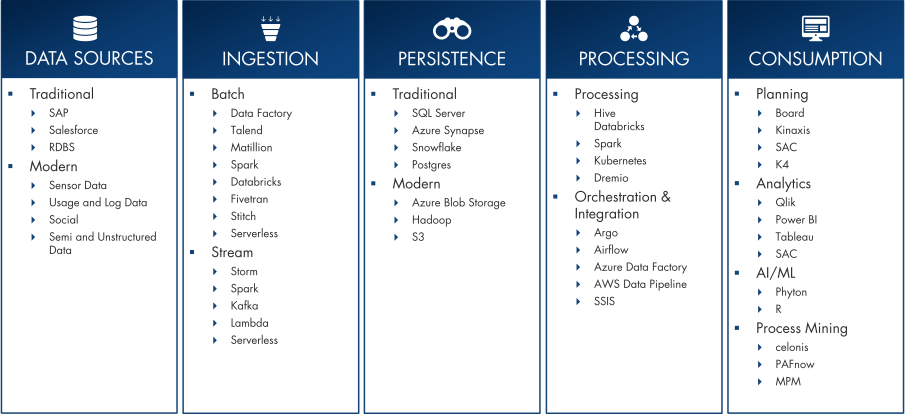
To turn potential into real value, data must be processed professionally along the entire chain—from source to decision. The following overview shows how modern data architectures enable precisely that: structured, scalable, and flexible data provision as the foundation for smart analysis and planning solutions.

Our consulting services in the field of smart data

Your challenges:

  • Data is used in isolation and unsystematically – resulting in a lack of economic added value.
  • There is no company-wide control system with a clear strategic focus and defined responsibilities.
  • Requirements for transparency, data protection, and compliance are increasing, but the organization is not equipped to meet them.

UNITY solution approach:

  • We work with you to develop a data strategy that is aligned with your company's business and transformation goals.
  • We create the organizational and structural foundations for reliable, secure, and economically viable data usage.
  • We establish a suitable governance model with clear responsibilities, rules, and standards as the basis for data-driven decisions, regulatory security, and efficient work.

Your challenges:

  • Historically grown, heterogeneous data sources make integration and real-time capability difficult.
  • Lack of scalability, outdated architectures, and insufficient standards slow down innovation.
  • Specialist departments demand data-based solutions, but architecture, management, and governance are not sufficiently coordinated.
  • Technical implementation is complex, and automation and central control are lacking.

UNITY's solution:

  • We work with you to develop a customized data platform strategy tailored to your business goals – from data lakehouse to event streaming to API management.
  • Based on this, we create a future-proof target architecture that is scalable, secure, and geared toward an efficient data infrastructure.
  • We establish structured data management with a metadata catalog, data map, KPI framework, and appropriate governance structures.
  • We implement modern, cloud-based platforms that are low-maintenance, automated, and future-proof – for reliable data, efficient processes, and data-driven decisions.

Your challenges:

  • Companies have a wealth of data at their disposal – but often lack a clear structure, responsibilities, and the right tools to gain actionable insights from it.
  • Specialist departments need both reliable standard reports and in-depth analyses, e.g., for forecasts, pattern recognition, or simulations.
  • Different user groups – from controlling to management – have individual requirements for data access, visualization, and decision support.
  • As data complexity increases, so does the need for powerful analytics solutions that combine classic BI reports with modern, AI-based evaluations.

UNITY solution approach:

  • We develop customized reporting and analysis concepts that provide specialist departments with relevant information in a targeted manner – automated, understandable, and relevant for management.
  • We integrate established BI tools (e.g., Power BI, SAC, Qlik) as well as AI-based forecasting and decision-making models – tailored to your use cases.
  • Whether standardized dashboards, ad hoc analyses, or intelligent forecasting models – we support you from the tool concept to implementation in your system landscape.

Your challenges:

  • Uncertainty about the specific requirements of the EU Data Act for your business model and data processes
  • Lack of transparency regarding data flows and access rights in complex system landscapes
  • Risk of compliance violations due to unclear responsibilities and a lack of governance structures

UNITY solution approach:

  • We analyze your current situation and work with you to identify areas for action in order to implement legal requirements in a targeted and structured manner
  • We translate regulatory requirements into concrete technical and organizational measures – practical, comprehensible, and future-proof
  • We support you in developing a company-wide data sharing strategy that is not only compliant with the EU Data Act, but also opens up new value creation potential

EU Data Act

[Translate to English:]
celver is our cloud implementation partner
Contact for customized solutions that form the basis for intelligent and data-supported decisions

For over 20 years, celver has been implementing complex planning and analysis solutions based on smart data architectures for customers from a wide range of industries and of all sizes. celver's goal: to jointly develop customized solutions that form the basis for data-supported decisions. With innovative concepts and technologies, celver provides support from specialist consulting to process definition, complete implementation and integration into the system landscape through to training, roll-out and change management.

Learn more

Projekt Stories Smart Data
  • Design, testing, and rollout of data governance

    As part of the project, a structured analysis and modeling of the change processes as sub-processes of the end-to-end meter-to-cash process was first carried out. Based on this, the relevant information objects were systematically assigned to company-wide business objects in order to create a consistent database. To ensure sustainable control, a data governance blueprint was developed that includes clear role and responsibility models – including a RACI matrix and standardized role profiles. Finally, the organizational anchoring of this blueprint was designed to pave the way for a scalable and iterative rollout within the company.

  • Designing a global data integration platform

    Design of a global data integration platform as a central data hub that ensures cross-departmental availability, security, and quality of data. Based on Azure Integration Services, an architecture was developed that seamlessly integrates both legacy and new systems—with the aim of gradually replacing existing systems and ensuring long-term interoperability. In addition to the technological target architecture, organizational aspects were also a focus: The platform approach was designed in such a way that self-service BI, automation, data-driven decision-making, and the use of artificial intelligence can be promoted and sustainably anchored. The application of established best practices resulted in a scalable and future-proof data infrastructure that serves as an enabler for digital transformation.

  • Building a future-proof data architecture

    Analysis of eleven key areas for the systematic identification of automation potential. Based on this, the relevant data architecture was verified and modeled to ensure data consistency and process integration. Particular focus was placed on defining the required data types, developing a viable process/business architecture, and further developing the existing data architecture at a functional and technical level, including the creation of functional data models, their transfer into business object models, and group-wide coordination with IT architects and related initiatives. In addition, process mining was strategically positioned and the integration of Fit2Standard analyses from a data perspective was ensured. This resulted in a robust data architecture as the basis for sustainable automation and data-based control.

  • Logo Eintracht Tech
    Data architecture for digital platform integration

    As part of the project, a comprehensive IT, software, and data architecture was designed to support a digital platform model. The aim was to create the technical basis for integrating external partners, digital products, and business models. This included designing central interfaces, establishing a consistent data flow, and developing a marketplace with a mixed shopping cart for the company's own offerings and those of its partners. A particular focus was placed on the modularization and integration of the architecture components, the connection of external content sources via a headless concept, and the implementation of an app to bundle all digital services. At the same time, an agile control model was established that integrates development and operation throughout the entire process, supported by modern DevOps practices.

  • Sales & Operations Planning

    A company-wide sales and operations planning (S&OP) system was designed and implemented, integrating sales, purchasing, and production requirements. The focus was on defining and implementing global planning processes with the involvement of all relevant stakeholders. Information flows were defined and the organizational anchoring of S&OP processes was ensured.

    A planning and simulation tool was used for the technical implementation, enabling a consistent, transparent, and simulation-capable representation of the S&OP process. The introduction was accompanied by targeted training and change measures to ensure sustainable use. The result was a significant increase in efficiency in demand and capacity planning, as well as a sound basis for decision-making for operational control at a global level.

Our experts for Smart Data

Daniel Gaspers

Head of Digital Services

Paderborn, Germany
Contact us

Dr. Michael Herbst

Partner, Business Area Team Lead

Cologne, Germany
Contact us

Jan Carstens

Manager

Paderborn, Germany
Contact us