


AI² Robotics
From concept to factory: Mapping humanoid robot use cases

By the end of this decade, the introduction of the Digital Product Passport will become mandatory for an increasing number of product groups and therefore for more and more companies within the EU.
A Digital Product Passport (DPP) provides transparent access to (mandatory) product information throughout the entire life cycle and provides, among other things, information on raw materials, other materials, substances, repairability, spare parts and proper disposal. It enables access to documents ranging from declarations of conformity to operating instructions. The DPP is already a central component of the European Battery Regulation and the new draft of the European Ecodesign Regulation (ESPR) for sustainable products.
Increased transparency of product data, its accessibility and exchange of information across system boundaries is the required goal of the DPP - both by legislators and by stakeholders along the value chain. The collection and consistent storage of this information, both within the company and from partners and suppliers, presents a challenge for processes and IT infrastructure, but on the other hand provides the potential to use this information beneficially, e.g. to achieve sustainability goals, increase competitiveness, strengthen the trust of users and consumers and meet the requirements of a future circular economy.
By introducing a Digital Product Passport, companies can create added value for themselves, their customers and society as a whole.
Sustainable transformation does not work without transparency. The DPP provides the basis for this - as a digital twin of the product across its entire life cycle, including its origin, composition and environmental impact. For companies, it is the key to meeting regulatory requirements and opening up new sustainable business models.
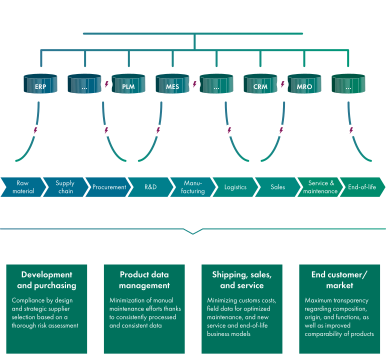
Data consistency ensures that relevant product information is consistently available across all systems and phases, including business partners. This is the only way to ensure that the DPP is up-to-date, correct and complete along the entire value chain.
Data is often fragmented and distributed across departments and IT systems. The challenge lies in harmonizing processes, creating interfaces and clarifying responsibilities for data quality - especially across company boundaries.
In addition to compliance, there is real added value: better decision-making bases, more efficient processes and new services - such as take-back offers or CO₂ balances. Companies that invest today will secure competitive advantages tomorrow.
Material compliance as a business-critical factor
Material compliance is no longer merely a bureaucratic ob- ligation; it determines market access and delivery capability. New regulatory requirements set the framework, but the real pressure arises within the supply chain: customers demand reliable material data. Any gaps quickly lead to delistings or loss of orders.
End-to-end processes for reliable material data
Together with companies from a wide range of industries, we ensure the availability of this data – from initial request through to integration into the IT system landscape. We design end- to-end processes, governance models, and data structures that not only ensure material compliance, but operationalize it and enable sales, procurement, engineering, and quality functions to work efficiently.
A springboard for digital services
Building on this foundation, we take the next step through lighthouse projects. Regulation defines market access criteria for specific product groups. Beyond that, the digital product passport becomes the central touchpoint with customers and partners. It expands transparency of product and material data across the entire lifecycle.
Transparency across the entire lifecycle
Based on semantic data models, we connect information from engineering, logistics, manufacturing, service, and return flows to enable, for example, refurbishment business models or intelligent spare parts supply.
Efficiency and full traceability
At the same time, we significantly reduce the effort required for product data management through consistent data handling and automated provision of evidence. In other words: full traceability from the initial engineering requirement through to reuse. In our projects, we combine regulatory compliance, efficiency gains, and growth potential – preparing our cus- tomers for markets in which transparency and reliable data exchange determine competitive positioning.

The DPP represents a wide range of data, information and documents that are created during product development, production and along the supply chain. These must be collected, aggregated and stored across system boundaries in order to provide a product-related, consistent data set at all times.

In order to create a complete set of DPP-relevant information for products, all companies involved in product creation and delivery must exchange relevant data with each other or grant partners and end customers access to this data.
This interoperability is simplified by a high degree of integration of the IT systems and portals involved, which guarantee authorized access, authenticity and data security.

Guarantee aThe contents of the DPP always relate to a specific product. This means that each product must be uniquely identifiable and digitally linked to the underlying data set.
To realize a unique product identification, process standards of configuration management can provide support to ensure the correct product configuration and documentation along the life cycle.

The Digital Product Passport makes it possible to precisely trace the origin and route of a product, from production to sale. This enables a transparent supply chain and helps to maintain quality standards, combat counterfeit products and minimize safety risks.

The basis of product-related data created for the DPP facilitates the implementation of current and future legal requirements in the areas of environmental protection, product labeling and circular economy (e.g. also reparability). A standardized format for environmentally relevant data simplifies reporting to authorities and compliance with regulations.

Being prepared organizationally without knowing the future regulations in detail.
The mandatory collection, storage and provision of data for the DPP is only made possible by a high degree of digitalization of the processes involved in the company. An early transformation ensures the necessary capabilities, even if legislation has not yet been passed in many areas.
Your challenges
UNITY solution approach


Intensify the contact between customer and provider created by the DPP by learning more about your customers, their requirements and how they use your products. Benefit from increased customer loyalty by using the communication channels established by the DPP.
Through an Environmental Product Declaration (EPD), you offer the advantage of comprehensive information on the environmental impact of products and enable conscious purchasing decisions.
Create an interoperable network with your partner companies as part of your digital transformation.
Go beyond the legal requirements during implementation, establish interfaces for secure data exchange and implement end-to-end processes across company boundaries. In this way, you can achieve increased transparency in the supply chain.
The provision of transparent product information in the areas of sustainability, traceability, environmental protection, etc. required by the DPP can be intentionally used to gain consumer trust. Regulatory requirements such as CSRD and CSDDD increase the reporting transparency of companies. It is important to design the transformation end-to-end effectively with a minimum of bureaucracy.
Depending on the topic, we provide you with the right experts. Select your preferred date from our calendar and discuss your concerns with our experts by phone or via Microsoft Teams without any obligation. We look forward to getting to know you!











Head of Digital & AI Services

Principal, Head of PLM & Digital Twin